
This post is also available in:
 Deutsch (German)
Wideband Cardioid™ Technology
Why do we need a loudspeaker with Wideband Cardioid™?
A conventional cardioid arrangement creates a null at the rear of the loudspeaker enclosure. In an active cardioid system, this is created by having two loudspeaker drivers located on the rear or sides of the enclosure, and processing them separately.
The cancellation is achieved around the centre frequency, equal to one quarter of the wavelength of the distance between the forward radiating source and the source at the side.
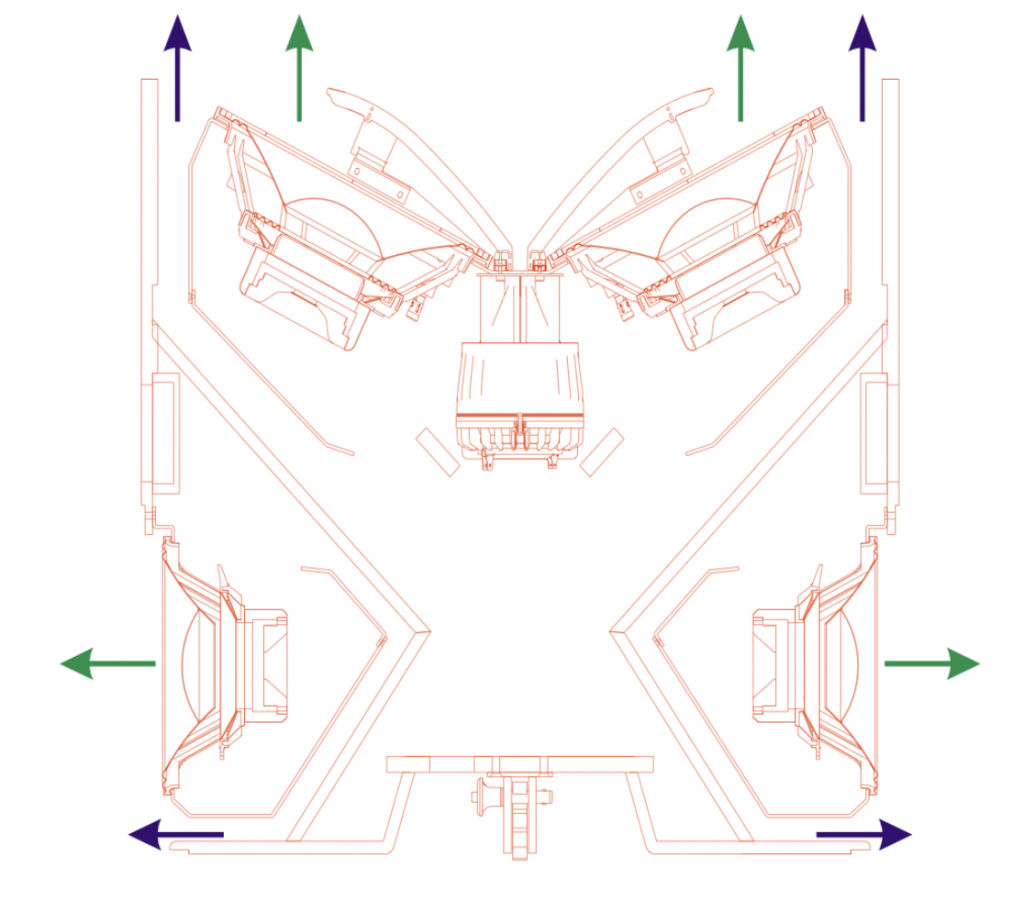
For example, with a path length of 75 cm between sources, the full wavelength would be 3.0 m
Then give that:
Frequency = Speed of sound/wavelength
F = 340/3.0
F = 113.33 Hz
So, the centre frequency of cancellation will be 113.33Hz, extending at best three quarters of an octave to either side, with the effectiveness decreasing as you move to the extremes. So, the cancellation range is to 67Hz to190Hz, centred at 113.33Hz.
This is a problem, as if we want the loudspeaker to have effective cancellation to it’s cut off point, the lower limit of the cancellation becomes the limiting factor in the low frequency extension of the loudspeaker.
How Does Wideband Cardioid™ Work?
So, the limitation with conventional cardioid is the bandwidth over which we can create the null to the rear of the cabinet, due to the distance between the forward and side/rear facing drivers.
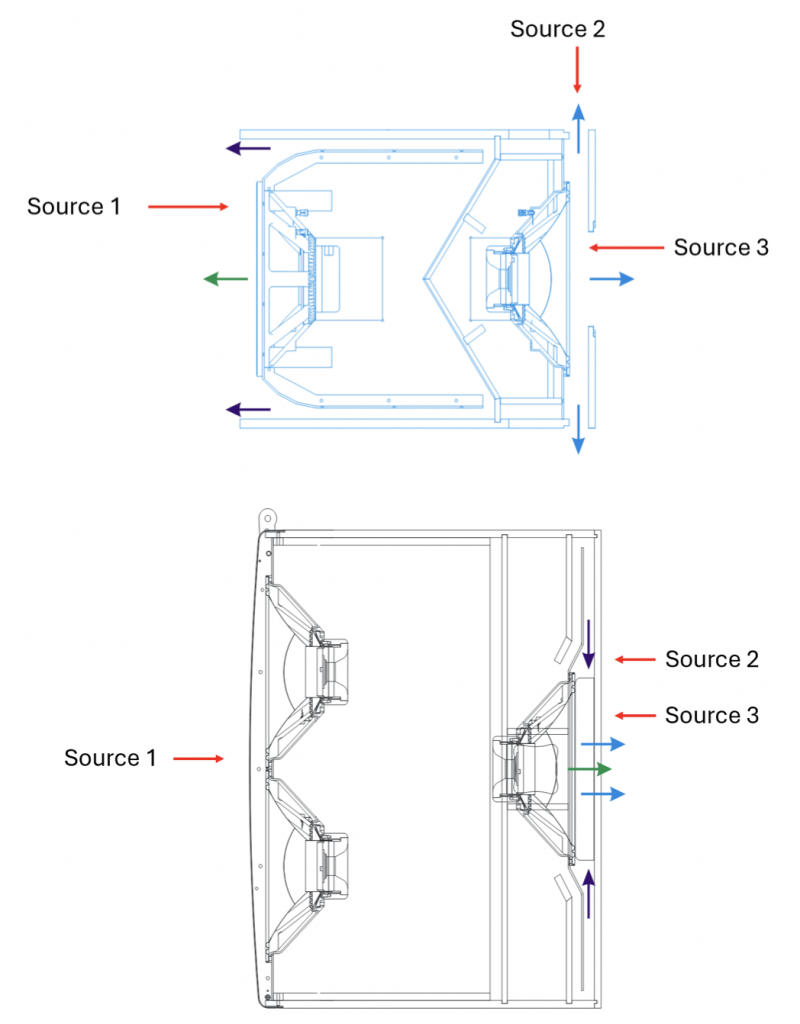
To overcome this, we can add extra acoustic sources to the cabinet – one closer to the source, one in the middle and one further away. This creates three path lengths, each one the centre of a new null frequency band.
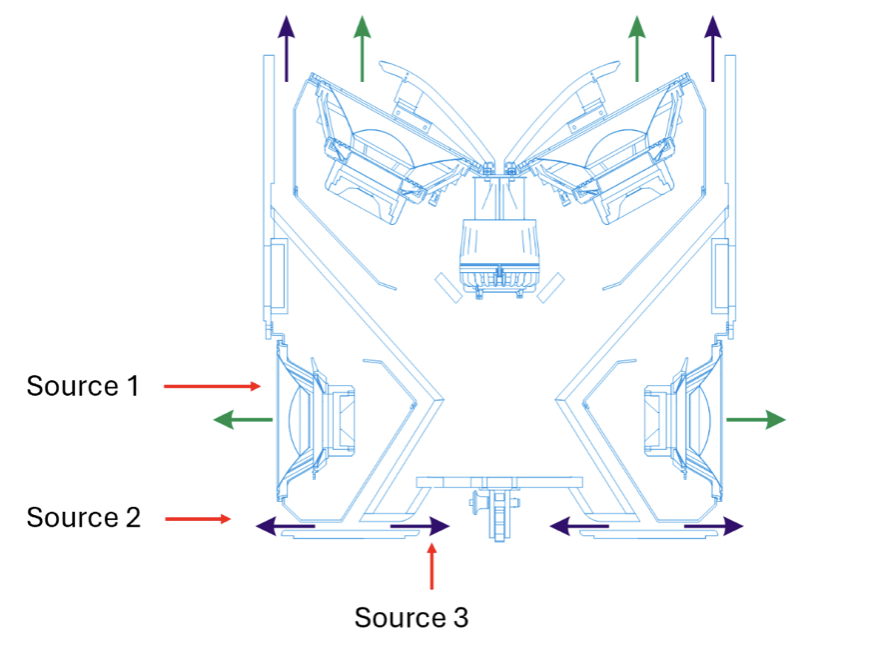
Our first distance is that from the front to the driver itself, the second is the distance to the first port on the side of the cabinet, and the third the rear port near the rigging point.
We will use the example path length distances of 50cm for source one, 70 cm for source two, and 90cm for source three.
Source one: f = 340/2 = 170Hz
Source two: f = 340/2.8 = 121.4Hz
Source three: f =340/3.6 = 94.4Hz
This gives an overall cancellation bandwidth of 56Hz – 286Hz, a significant improvement, and allowing the loudspeaker in question to have a much lower low frequency cut off point, as the cancellation null works to a lower frequency.
Changing the distances from the front to the three rear radiating sources, allows you to change the effective frequency range of the null.
It is not just a matter of path length difference, but also of port tuning and port energy.
The shortest path length is to the diaphragm itself, representing the higher frequency range of the cancellation system. (purple curve below). The longer path lengths for the lower frequencies of the cancellation system are to the ports, which are appropriately tuned to the correct frequency for the path length. The shorter port is to the very rear of the cabinet, providing the highest cancellation energy (grey curve).
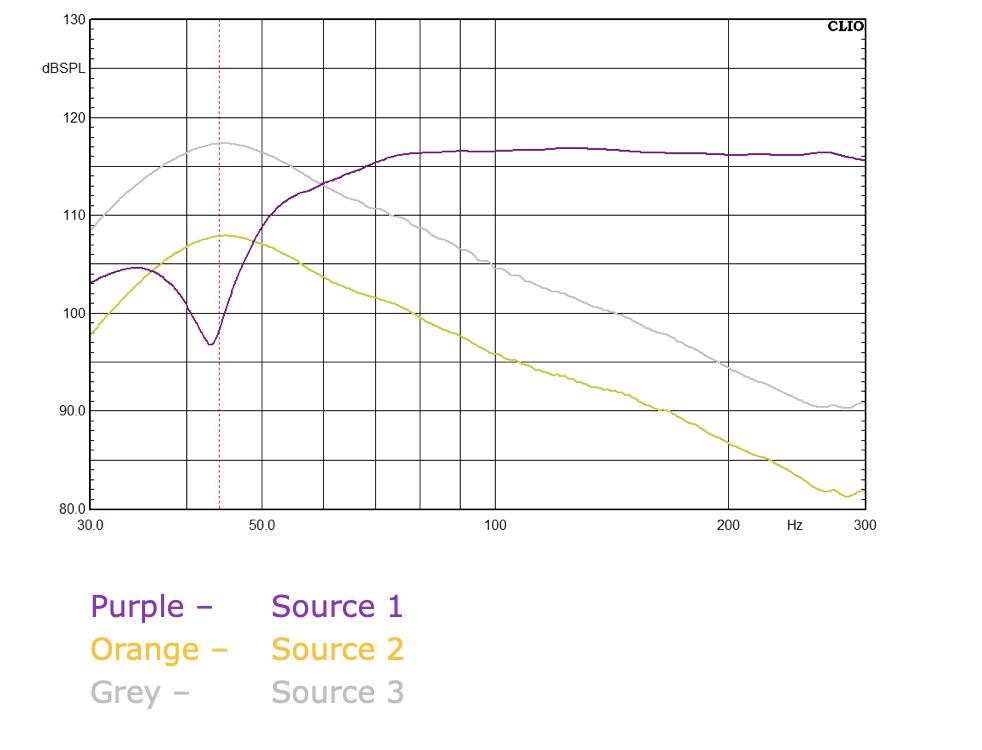
The resultant cancellation at the rear of the cabinet is significant and over a wide bandwidth.
The plot below shows the difference in attenuation between having two ports the same length (blue), and one shorter than the other (green). The reference is the 0dB line.
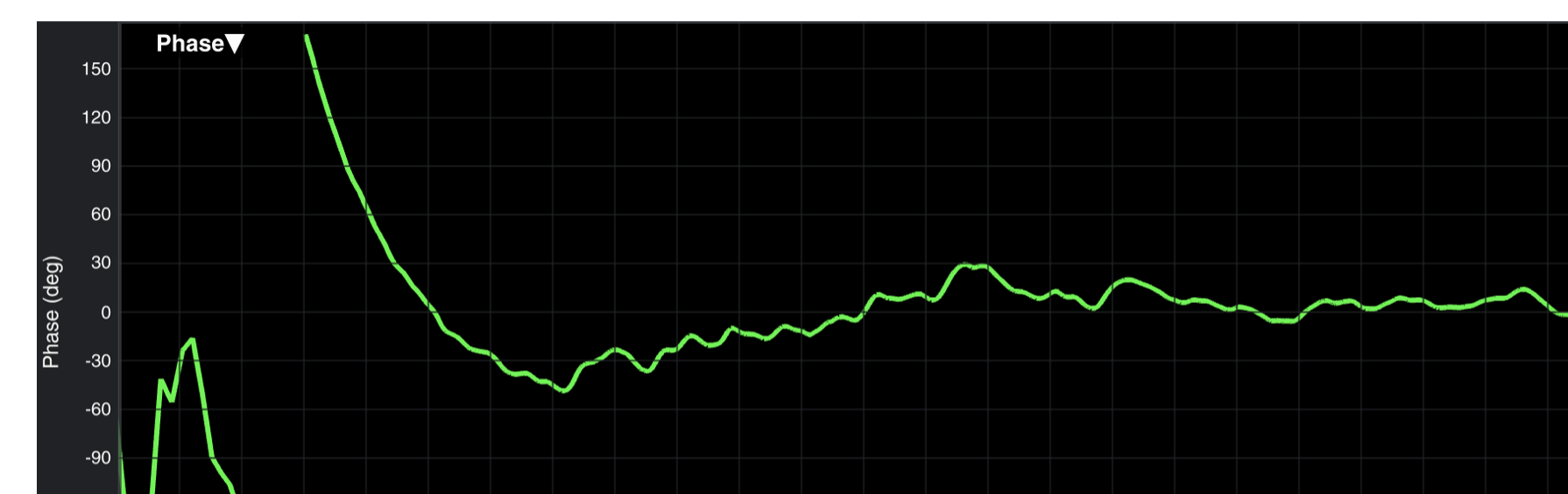
Phase response of Wideband Cardioid™
Typically, cardioid systems can exhibit poor phase behaviour. This result in a soft sounding low frequency performance, lacking punch. This is because there is delay between the arrivals of each frequency band at the listener.
Also, for proper control at low frequencies, a typically FIR filter would need around 45ms of processing time, clearly not acceptable.
By applying CODA’s DS-FIR filtering, we can achieve all that control, but with much lower latency, typically around 12.5ms.
We also provide low latency presets for use in time critical applications, such as side fills and monitoring, at the cost of some phase linearity at the lower frequencies.
Applying Wideband Cardioid™ to Subwoofers
The rules stay the same, regardless of loudspeaker type.
With a conventional cardioid subwoofer, there are two issues.
The first is that we have only one path length, so a narrow band of cancellation. This is a particular problem for CODA, as we want our subwoofer to be able to operate up to 200Hz. This means the same cabinet can be used to increase LF energy and extension in the air with the arrays, as well as perform efficiently on the ground.
The second is that you cannot place a cardioid subwoofer up against a wall, as:
The subwoofer cannot create the rear null with no space in which to radiate
Close proximity to a hard wall will result in large backpressure on the loudspeaker, causing damage to the driver itself.
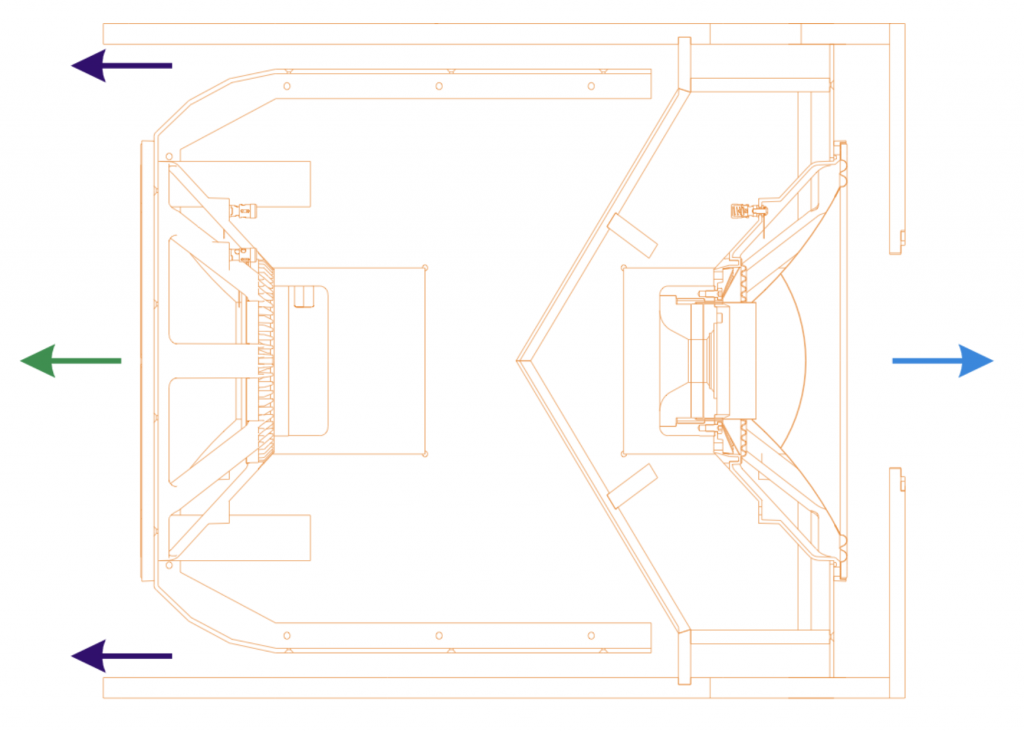
CODA’s Wideband Cardioid™ subwoofers do not suffer from these problems, as the rear facing driver is also vented to the sides of the cabinet.
When the loudspeaker is away from a wall, we have multiple paths of cancellation, as we do with the partner loudspeakers, but when against a wall the rea facing driver can still add extra LF energy from the side firing ports without damaging the driver.
Conclusion
Through careful and considered design, CODA have shown that it is possible to operate a wide frequency band cardioid design, of above average performance whilst also maintaining a flat phase response from the loudspeaker system.
The benefits to the user are a quieter stage, improved off site level controlled and a clean, precise and impactful subjective performance.